Main Street Detroit Takes Shape
Neighborhood shopping in Detroit isn’t what it used to be.
It’s getting better.
Some of Detroit’s traditional commercial streetscape beyond downtown is being renewed through a community-based approach combining four city programs with new zoning for neighborhood business districts. This approach stimulates entrepreneurial business development through incremental change, according to Alan Levy, director of the Mayor’s Office of Neighborhood Commercial Revitalization.
The city has leveraged $4.25 million in municipal and private foundation funds into more than $12 million in private investment and new construction in five neighborhood business districts: Jefferson East Business District, Grand River Business District, Mexicantown, “The 7-Mile Project” (East 7 Mile Road, between John R. and Woodward) and University Commons (Livernois, near University of Detroit Mercy).
Recently, changes in the city’s zoning ordinance allows for business “traditional main street overlay districts,” which provides specialized zoning, such as limited parking requirements and the ability to rent upper floors of businesses for residential use, to encourage small business development.
Detroit initiative is modeled after the National Trust for Historic Preservation Main Street Center’s “comprehensive” approach. The Main Street approach involves a public/private partnership, offering support in organizational development, promotion, urban design and economic restructuring. Detroit emphasizes small business development and making the districts “clean and safe.”
Aside from the aesthetic value of restoring older buildings, renovation is generally less expensive than building new buildings, thereby allowing lower rents, says Levy. “A new strip mall is going to have fairly high rent to cover construction costs. In terms of being incubators for new businesses, these areas can do that because they have, by definition, lower rent.”
The Jefferson East Business Association (JEBA) last year received a Cool City catalyst grant from the State of Michigan to establish an entertainment and technology incubator. The grant assists property owners with $25,000 façade improvement grants in exchange for leasing space to entertainment or technology businesses for lower rents for up to three years.
“This is our way of incubating those businesses,” explains Diana Stewart, JEBA executive director. The grant includes a business assistance program provided by the association, which offers professional consulting services in business and marketing plans, as well as financial loans.
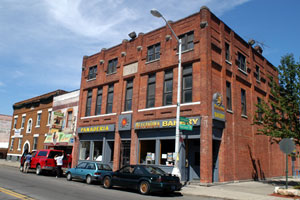 The Southwest Detroit Business Association (SDBA), an early proponent of the Main Street model in Detroit, is also a recipient of a Cool City grant to redevelop a former Odd Fellows Hall into a cultural center, linking the largely Hispanic area of Detroit with Middle Eastern South Dearborn.
The “clean and safe” element of the Detroit approach is critical says Kathy Wendler, SDBA executive director. “People want a clean shopping environment and want to feel safe when they’re shopping,” she says.
The association has worked with neighborhood organizations to maintain the vibrant West Vernor shopping district. A “clean team” of volunteers patrol the streets daily to pick up garbage and monitor graffiti.
The Southwest Detroit and East Jefferson business districts each employ community policing strategies which include crime prevention and safety promotion, as well as area surveillance, in conjunction with their local police precincts.
Consumer behavior is different today, than when Detroit’s commercial districts were built, Levy says. The neighborhoods didn’t have retail options. “There weren’t shopping centers. There weren’t big boxes (warehouse stores). You didn’t have the Internet. … The environment we find ourselves in is extraordinarily competitive. If we maintained that one of these areas was going to make it just on providing neighborhood services as they did in the ‘30s and ‘40s, it’s not realistic given the level of competition today.”
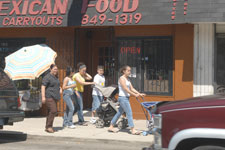 For districts like Southwest Detroit, a traditional shopping district makes economic sense. The predominant Latino culture in the area is loyal to the merchants who speak Spanish and share their culture. Unlike other areas of the city, there is an abundance of food markets, as well as clothing stores, professional services, bakeries and restaurants on West Vernor.
The “walkability” and “pedestrian scale” of West Vernor is its competitive advantage, says Wendler. “It’ where people go to see and be seen, meet and greet and push their babies and walk around in their finery on days when it’s appropriate to do that. The street is not just for cars, it’s for people.”
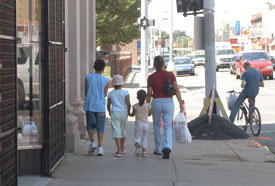 “Instead of doing one big shopping (trip), you can walk to a market and get fresh produce and fish or meat for that evening’s meal. If you walk to the bigger supermarket, they’ll tell you that they have to be on their toes to compete.”
SDBA promotes “Shop Your Block” in August, as well as a holiday shopping event in December to boost business.
Other business districts need to find a “niche” without becoming alien to their neighborhood communities. That’s a delicate balance, Levy says. A strong community adds value to the local business district, but community involvement is only part of the redevelopment “puzzle,” according to Levy.
“For example, you could be successful without having any community involvement at all. It would be very, very hard. You could be successful by having nothing but community involvement. That would be very hard,” Levy says.
“As a community-based methodology, we think it’s a core value to get the community involved. It’s a huge resource in terms of time, expertise. The groups that can get their community involved and the community feels a sense of ownership in the long run will be the most sustainable.
“When you talk about being competitive, what makes these areas unique and have a unique selling proposition, is that there is a sense of community there; that they do have a unique niche in the market place.”
Jefferson East encourages community involvement in its development activities, says Stewart. “We have a good percentage of community residents attending our quarterly meetings.” The association works with block club coalitions to solicit information from residents regarding area business development.
“Our goal is to revitalize the commercial district within our boundaries with recommendations of the members and (community) stakeholders.”
Just as people fill the street in Southwest Detroit to shop, people literally fill the street for Jefferson East’s annual free jazz and blues festival. The day-long event features local and national entertainment and provides a showcase for community merchants and organizations.
The incremental approach to revitalizing these commercial districts takes time and patience, but in the end it has greater permanence, says Levy. “What happens over time, you have people who start out with nothing – entrepreneurs – they go into business, then buy their building and you have real wealth created by local Detroiters.
“If you had to choose between a program that makes that possible, versus a program that provides six part-time jobs working for a franchise, which one is the better way to go in the long run?
“That’s what we’re trying to get to – investment by locals, in the local community and to keep that money in the community.”
Mayor’s Office of Neighborhood Commercial Revitalization
The City of Detroit Office of Neighborhood Commercial Revitalization (ONCR) has committed $2.4 million over five years and the Local Initiatives Support Corporation (LISC) has committed $1.8 million over three years to create four commercial renewal programs. Districts demonstrate a five-point urban redevelopment approach to redevelopment: organization, promotion, design, economic restructuring, and clean and safe initiative. An advisory board including mayoral city council, foundation, business and community members, provides program oversight. Programs include:
• Restore Detroit: Community business and development organizations compete for financial support to hire full-time staff to manage development. In addition to the financial support, staff and volunteers of the organizations receive training and technical assistance to create a work plan. This qualifies the district for further assistances through the other three programs.
• Refresh Detroit: This program provides matching grant funds and architectural assistances for façade improvement. These funds are administered locally, as incentives for property owners and merchants to invest in the area.
• Recap Detroit: National City Bank is the financing partner in this program, which provides lower interest loans below market rate.
• Renew Detroit: This program helps sustain local revitalization by increasing the knowledge of local stakeholders through technical assistance and training.
For more information on these programs, contact Alan S. Levy, director of the Mayor’s Office of Neighborhood Commercial Revitalization at 313-224-ONCR or visit www.ci.detroit.mi.us/mayor/oncr.
Related Articles
Juneteenth: Freedom’s promise is still denied to thousands of blacks unable to make bail
Just as with so many other criminal justice policies, pretrial detention disproportionately affects African-American men and women, destabilizing black families in the process.

Michigan Adventurer to Bike 1,000 Miles Across State to Spotlight Hidden Form of Domestic Abuse
A Michigan adventurer is biking over 1,000 miles across both peninsulas this summer to raise awareness about economic abuse: a hidden form of domestic violence that affects countless survivors across Michigan.
Detroit schools are making real gains in reading and math: 4 strategies that are working
The city’s schools are making progress faster than peer districts, but that progress could be fragile.