Central Woodward Neighborhood Guide
Historic
homes and ornate cathedrals and churches. Opportunities for investment
and growth in a prime central Detroit location. Close to downtown, the
New Center and a short distance by car to the northern suburbs. Welcome
to Central Woodward, a racially, economically and architecturally
diverse neighborhood looking to reverse decades of decline and restore
its place as one of the city’s top residential districts.
A banner hanging from a front yard fence facing Woodward Avenue in
the Historic Boston-Edison neighborhood reads, “If you lived here you’d
be home now.” It seems the writer wants passersby to know that this is
a residential neighborhood people call home.
Located between the John C. Lodge and Chrysler freeways, and Euclid
and Webb streets, the area known as Central Woodward is a vast
residential tract developed in the early 20th century.
Central Woodward was initially economically diverse – poor factory
workers lived in tiny apartments on Third Avenue and rich auto barons
lived on Boston Boulevard, with everyone else in between. The chasm
between rich and poor has narrowed considerably, but the diversity
remains, not only in the residents’ income levels and racial
backgrounds, but in the architectural styles as well.
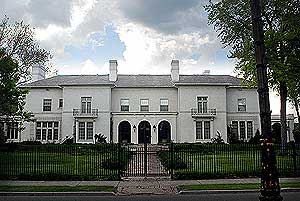 Each December, hundreds of people tour Boston-Edison and its sister
historic district, Arden Park across Woodward, during a holiday homes
tour. The neighborhood is the center of the historic house universe
during the tour, when busloads of people, some from the city but many
from the suburbs, get an inside view of the beautifully restored homes
and others in various stages of restoration. Historic figures like
Ford, Fisher, Kresge, Hudson, Detroit Tiger great Ty Cobb and Motown
founder Barry Gordy are among the personalities who lived in the
neighborhood. Now, the real celebrity is in the architectural wealth of
the old houses — and their biggest fans are their owners.
The historic districts are the anchors of economic stability for
Central Woodward, says Jim Hamilton, president of the Boston-Edison
Homeowners Association. Along with many other historic homes located
throughout Central Woodward, the area offers “one of the most
spectacular collections of residential housing in the metropolitan
area,” Hamilton says. “Thousands of wonderful houses, many of which are
not in great shape, but it’s the raw material (that is so impressive).”
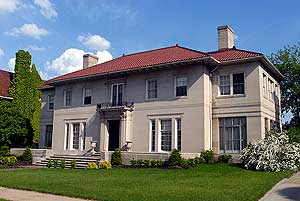
Prairie style, Colonial Revival, Neo-Georgian, English Revival,
Shingles Style, Tudor, American Vernacular and International are among
the many housing styles found in Central Woodward.
 The Boston-Edison tour begins and ends with the Sacred Heart Seminary and Chapel
on the corner of Linwood and Chicago Boulevard. Built in 1924, the
seminary features an English Tudor-Gothic architectural style and is
fitted with solid oak furniture and Pewabic tile flooring. It
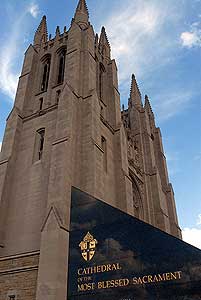
complements the Roman Catholic Blessed Sacrament Cathedral
on Woodward Avenue, between Boston-Edison and Arden Park. In addition
to Blessed Sacrament Cathedral, there are at least six grand historic
churches within a few blocks, including Historic Little Rock Missionary Baptist Church and Metropolitan United Methodist Church,
in the area once known as “Piety Hill.” Each Sunday, you’ll find
Woodward lined with cars. These spacious old houses of worship have
maintained core congregations and help define the architectural
character of Central Woodward. Also on Sundays, it’s not unusual to see
cars cruising slowly through the old leafy neighborhood streets,
admiring the lifestyle of the once rich and famous, and dreaming,
perhaps, of their own place in the historic mosaic.
A ‘redemptive area’
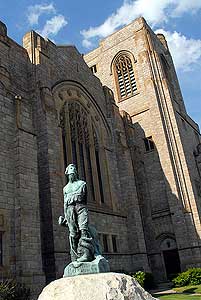 Although the area is known for its designated historic districts, it
is also a vast residential area that suffered considerable decline
during the late 20th century. The area features impressive
houses throughout, but many are in disrepair and occupied by people
often unable to maintain them properly. “If you look at Central
Woodward, you have pockets of stable housing and large pockets of
vacant land and substandard housing,” says Michelle Bush, a planner
working with the Local Initiatives Support Corporation
(LISC). LISC has established a Strategic Investment Area, which
involves collaboration between community development corporations
working in Central Woodward to better plan redevelopment efforts. The
LISC collaborative is examining five areas of concern:
• Preserve the high quality housing remaining in the area;
• help preserve and protect homes owned by senior citizens;
• reduce blight and increase code enforcement of retail areas;
• increase recreational opportunities;
• and improve schools.
Despite its problems, Bush says, “what’s appealing about the Central
Woodward area is (that it has) its mixed income and mixed housing,
(with) a more stable neighborhood and strong business district in close
proximity.”
 This has been a longstanding concern of Jim Turner’s, a resident of Arden Park
and member of the Detroit Historic District Commission. He believes
that the recent implementation of the LISC collaboration is an
important step toward linking the New Center with the historic
districts to the north. Turner believes that New Center can be linked
to other residential neighborhoods “through the redevelopment and
adaptive reuse and possible preservation of the homes within the area.
That includes providing education to homeowners on methods they could
use to maintain their property in a more efficient manner, not just the
wholesale replacement of components in their homes.”
The fact that low income residents live in the area shouldn’t be
perceived as a problem, Turner says, but as an opportunity. Many
believe one of the strengths of the area is the potential of
redeveloping an area of mixed incomes, along with the mixed
architectural styles. For years, Turner says, the area has been “a
model that keeps people stuck in one living arrangement (but) there’s
an opportunity to be creative in redeveloping the area.” A goal is to
encourage people to move from rentals to affordable rate condos or
single-family homes, instilling pride of ownership.
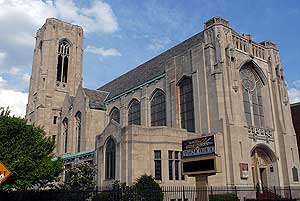 Rev. Jim Holley, pastor of Historic Little Rock Missionary Baptist
Church and a leader in faith-based economic development, believes that
it’s part of his church’s ministry to help develop what he calls the
“redemptive territory” and calls upon other faith-based community
development efforts to fill the void. Little Rock has long been a
proponent of faith-based economic development in Detroit. Beginning
with the Country Preacher cookie franchise launched several years ago
and continuing with the recently developed strip mall containing a
Subway franchise and Jaws,
a local fish carryout restaurant, Rev. Holley has demonstrated that the
churches can help create community development in the absence of
commercial investment. In addition to Little Rock’s retail ventures,
Rev. Holley says that his church is planning to build 175 single-family
houses east of Woodward, selling for $120,000 each.
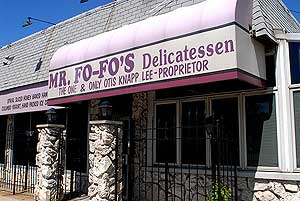 Another faith-based community development corporation, Central Detroit Christian (CDC), recently announced the acquisition of Mr. Fo-Fo’s
deli on Second Avenue, which has been a fixture in the area for many
years. Plans are to convert it into a full service family restaurant
with seating and an ice cream parlor. Additional plans call for a fruit
and vegetable market. “This is an area that is ripe for redevelopment,”
says Lisa Johanon, CDC president. The organization has gone where no
for-profit would venture to restore housing in the area immediately
south of Boston-Edison. It’s not for the faint-hearted investor – in
fact, it may still be too risky for a profit-oriented investor, Johanon
says.
“These are hard economic times for the city of Detroit and the state
of Michigan,” Johanon says. “If anyone comes with a pie-in-the-sky idea
that if they build it they will come, they’re foolish. You’ll have to
work.” However, the need for housing and basic community retail
services like a cleaners and laundromat, remains strong, she says.
There are 300 vacant lots in the CDC’s service area alone. Johanon says
that 36 percent of Central Woodward’s population is below the poverty
line.
Neighborhood economics
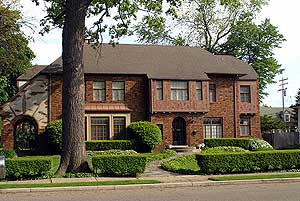 On the other hand, Boston-Edison, Arden Park and the historic
neighborhoods in the New Center contain middle- to upper middle-class
homeowners. Boston-Edison is the only neighborhood in Detroit to have a
development corporation with residential investors. The Boston-Edison Development Corporation, Inc.
(BEDI) renovates abandoned houses in the neighborhood and sells them at
a competitive rate, minimizing blight and introducing new residents to
affordable housing options. BEDI has been renovating houses in its
neighborhood since 1990, the only development corporation that has
raised funds from residents. To date, eight houses have been
rehabilitated, seven of which have been resold. Because the houses
range in size and location, their resale values range from $67,500 to
$170,000.
Boston-Edison has noted a good news/bad news scenario in the housing
market. On one hand, home values have increased in recent years. On the
other hand, the economic downturn has caused increased mortgage
foreclosures: good news for homebuyers, bad news for home sellers,
according to Marilyn Mitchell, president of the Boston Edison
Development Corporation who lives in the Henry Ford mansion on Edison.
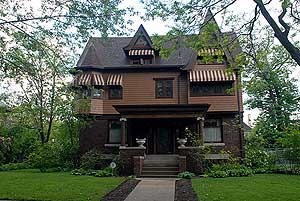 Housing values have increased outside the historic districts as
well. Johanon, who lives in an historic house on Taylor – walking
distance from her Second Avenue office – has seen the value of her
house increase more than five-fold since purchasing it for $22,000 in
1989. New infill housing, designed with the same general dimensions as
other houses in the neighborhood, is selling for $86,000.
But Boston-Edison Homeowners Association President Hamilton says
residential economics in urban Detroit provides an unfavorable
environment for selling or buying, given the complex peculiarities of
the market statewide. “The economics of buying a house requires a
careful consideration of utility costs, which tend to be higher in the
larger old homes,” says Hamilton, who adds that insurance and taxes
also tend to be higher. “That’s where the problem is for current
homeowners who want to sell their homes for somewhat close to market
rate, yet buyers are unwilling to accept all of the other costs as
well. If the heating costs are higher, the insurance is higher, the
taxes are higher – those don’t stop people from buying a house. It all
gets discounted into what you’re willing to pay for it.” In other
words, if the cost of the house is low enough, the buyer will justify
the other factors. That’s not good news for current homeowners, however.
“What they (home sellers) need to do is drive the prices of their
homes down. That’s just the way the market works,” says Hamilton, an
economist. “Everyone’s saying that people can’t sell their houses
because of high taxes, high insurance, high heating bills. No. The
reason they can’t sell heir houses is that they won’t lower the price
to compensate.”
Crime is also an issue for homeowners in Central Woodward, says
Central Detroit Christian’s Johanon. People who choose to live in the
area accept the risk of property theft, but adopt crime prevention
behavior as second nature – from walking with dogs and mace to
equipping their houses with alarm systems. But Johanon says that the
majority of residents are law-abiding, good neighbors. “For every
knuckle-head out there, there’s at least five good families,” she says.
Crime may be what everyone talks about, but, ironically, it also
serves as a galvanizing force among neighbors, Hamilton says. “Crime is
a curious thing. It’s a problem that everyone worries about, and yet
it’s something that draws people together.” Communities, he says, are
strengthened by common interest. In Boston-Edison, security is an
interest, as is home restoration. “One of the reasons that this is such
a great community is that we have interests in common – but one’s
positive and one’s negative,” Hamilton says.
He and wife Cleo, longtime Boston-Edison residents, are street-smart
urban people who are undeterred by fear. It’s not so much denial as
defiance. They’re cautious, but walk regularly in the neighborhood and
as far as Henry Ford Hospital, a mile away. “I think we could walk
downtown and not find a scary place,” says Jim Hamilton. Integral to
personal safety and housing values is the symbiotic relationship
between the historic districts and its adjacent neighborhoods,
something that is not lost on the LISC collaborative. There is no
exclusivity, he says. The affluent residents of the historic districts
know, “the better the surrounding area is, the better off we are.”
Retail development on Woodward
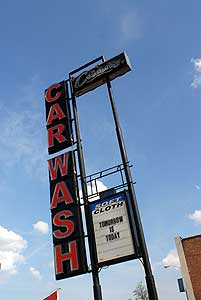 Julian Hill saw a vacant car wash and a busy Woodward Avenue and
concluded the obvious – something that wasn’t obvious for about a
decade: People need to wash their cars. After buying the Celebrity Car
wash, he bought out his competition in the New Center and closed it.
Now, he has the only automated car wash on Woodward between Highland
Park and the Detroit River. As a result, he hasn’t had a bad day since,
except, of course, when it rains or snows. “If you build something
that’s appealing to people, they will patronize your establishment,”
Hill says.
There are opportunities for retail development along the area’s main
thoroughfares, but Hamilton isn’t convinced that there is a need for
all kinds of services. “Another thing I find attractive about this
neighborhood is that it does not have a restaurant district, or
an entertainment district. In fact, I don’t think we want a restaurant
district and an entertainment district. What we have is proximity.
We’re close to all of it. We’re five minutes from downtown and
everything between here and there: ballparks, symphony, Midtown and New
Center restaurants, not to mention the restaurants in Hamtramck. The
art museum is minutes away.” There are at least three decent grocery
stores to pick from in addition to Eastern Market, as well as two CVS
stores. For those who need anything from a two-inch screw to power
tools, the old fashioned Detroit Hardware Store generally has what
you’re looking for. It may not be a Home Depot, but people with old
homes need a good hardware store nearby more than they need a warehouse
store.
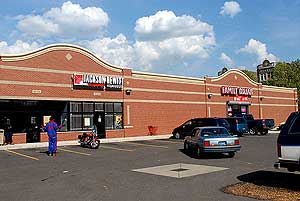 In addition to Little Rock’s shopping center, a second was developed
recently, including a Jackson Hewitt tax service office and Family
Dollar store. This is viewed as a healthy sign that retailers are
beginning to serve the needs of the local residents. “The thing people
bemoan the most is lack of shopping,” says Hamilton. “I have to say
that I’ve been pleased with what’s been happening with retail in the
past several years.” Some complain that the area doesn’t need a dollar
store, but Hamilton contends that they are the very thing that’s
needed. They represent the “dime stores” of the early 20th
century, he says, serving the needs of lower income working families.
Another good sign, he says, is the upgrading of King Cole, the only
local grocery store serving Central Woodward. Neighbors also complain
that there isn’t a Target and other “big box” retailers, but Hamilton
says, “I’m not sure that there’s enough population with that kind of
income to support one. We still have to go out of the area for that
kind of shopping. But that’s an occasional thing, not an every day
thing.”
As in other areas of Detroit, financing is a barrier to small
businesses developing in Central Woodward. After several loan requests,
Julian Hill’s car wash was finally launched with nearly $500,000 from
Shore Bank for facility improvements and equipment. “There are a lot of
people with great dreams,” Hill says, “but they’re unable to get them
financed. There are lots of opportunities in this area, between the New
Center and Highland Park. It’s the small business owner that connects
the dots between (larger businesses and institutions). I believe that
if individuals work hard to keep up a good appearance, they are
diligent in the study of their industry, they understand their market
and their consumer, and they understand their product well, I believe
they can be a success.”
Revival of a place she’s always called home
Denise Gray has never lived more than a block from where she was
raised on Atkinson Street, just south of Boston-Edison. She has seen
the area deteriorate after the 1967 riot, and recently has witnessed
its revival. A department manager at 36th District Court and
a management instructor at Cornerstone University in Troy, Gray led a
busy professional life until she began noticing a change in her
neighborhood on Taylor Street a few years ago: Children appeared to be
better behaved. New single-family houses were being constructed and
social activities were being provided by Central Detroit Christian.
That revived a community sensibility within Gray that caused her to
join the CDC Board of Directors. “Being an active Board member, I could
provide input and help raise some dollars and watch the neighborhood
enhance itself. That’s what’s been happening. It is holistic in its
approach,” she says.
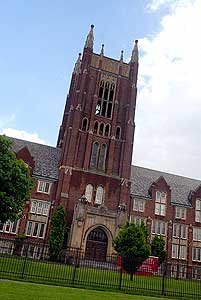 The revival of retail shopping on Woodward and the renovated King Cole
grocery store are examples of why “this a great place to live,” says
Gray. “It’s a good investment if you’re going to also invest in your
community. You have to be mindful that crime is all over the city and
when certain things begin to happen in the neighborhood, you must be
responsible and report it proactively so it doesn’t get out of hand.
I’m always telling folks to stop dumping trash, and when you see it,
report it, because it will simply build up.”
Gray believes a major ingredient in the revival of Central Woodward
is increased home ownership. The market conditions are such that it’s
difficult to buy or maintain a house in the area if you’re of modest
means. However “when folks move here, they love it,” she says. “We
realize we have some challenges that we must deal with as a community.
(But) we are the ones who will make it happen with the support of our
leadership. Without the support of our leadership, nothing will happen.”
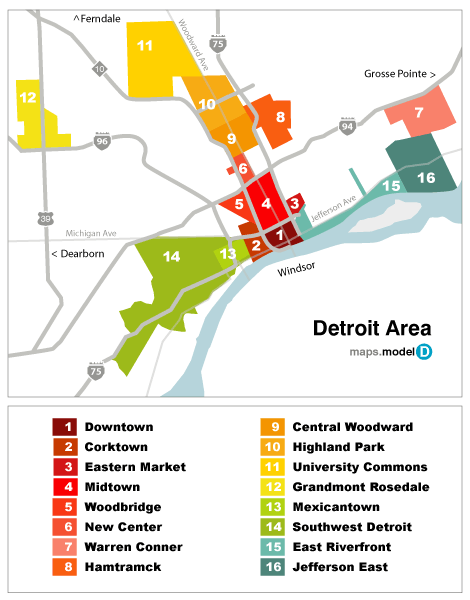
Directions to Central Woodward
From the East:
Take I-94 West and take the
M-10/Lodge Fwy North via Exit 215B. Merge onto John C Lodge Fwy/M-10.
Take the Hamilton Ave exit – Exit 6A – toward Chicago Blvd. Turn slight
left onto Hamilton Ave and turn right onto Chicago Blvd. Arrive in
Central Woodward.
From the North:
Take I-75 South and take Exit
56B for the Davison Fwy West. Take the exit toward Oakland Ave and turn
slight left onto E Davison. Turn left onto Woodward Ave and arrive in
Central Woodward.
From the West:
Take I-96 East and merge onto
I-94 East via Exit 190A toward Port Huron. Take the M-10 North exit –
Exit 215B – on the left and merge onto John C Lodge Fwy. Take the
Hamilton Ave exit – Exit 6A – toward Chicago Blvd. Turn slight left
onto Hamilton Ave and turn right onto Chicago Blvd. Arrive in Central
Woodward.
From the South:
Take I-94 East toward Detroit
and take the M-10 North exit – Exit 215B – on the left. Merge onto John
C Lodge Fwy North. Take the Hamilton Ave exit – Exit 6A – toward
Chicago Blvd. Turn slight left onto Hamilton Ave and turn right onto
Chicago Blvd. Arrive in Central Woodward.
Take I-75 North toward Detroit. Merge onto I-96 West via Exit 48 on
the left toward Lansing. Merge onto I-94 East toward Port Huron. Take
the M-10 North exit – Exit 215B – on the left. Merge onto John C Lodge
Fwy North. Take the Hamilton Ave exit – Exit 6A – toward Chicago Blvd.
Turn slight left onto Hamilton Ave and turn right onto Chicago Blvd.
Arrive in Central Woodward.
Related Articles

Michigan Adventurer to Bike 1,000 Miles Across State to Spotlight Hidden Form of Domestic Abuse
A Michigan adventurer is biking over 1,000 miles across both peninsulas this summer to raise awareness about economic abuse: a hidden form of domestic violence that affects countless survivors across Michigan.

Detroit schools are making real gains in reading and math: 4 strategies that are working
The city’s schools are making progress faster than peer districts, but that progress could be fragile.

From brunch to wellness, here are some ways to celebrate Mother’s Day in Detroit
From brunch and dinner specials to wellness and healing-centered experiences, several Detroit businesses are offering plenty of ways to celebrate Mother’s Day.