Look Outside: Top 10 Public Spaces
Step
outside to explore Detroit’s architecture via its best public spaces —
from boulevards with Roaring Twenties grandeur to quintessential urban
city squares to sprawling parks and natural areas.
AIA-Detroit’s Urban Priorities Committee continues its look at the
city’s best architecture with its list of Detroit’s 10 best outdoor
public spaces. The group, whose members include prominent architects,
planners, educators, designers, construction managers and journalists,
reviews, critiques and generates projects for metro Detroit. The group has also brought Model D guides to its top 10 interiors and downtown buildings. Here’s a
peek inside their favorite buildings around the city, with their own
comments and using their “AIA Guide to Detroit Architecture” as a
reference.
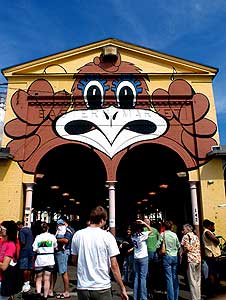 1. Eastern Market
Various architects
1841
For more than 200 years, Eastern Market has provided Detroit fresh food
for both local and commercial consumption. The market was originally
founded in Detroit’s Cadillac Square and moved to its current location
just northeast of downtown Detroit in 1841. Today, the site spreads
over 43 acres and incorporates several sheds for producer and
wholesaler sales. It is further flanked on all sides with historic
structures containing permanent private wholesalers. Given the market’s
unique fare and array of fresh produce, it remains one of Detroit’s
most eclectic and dynamic spaces throughout the week. Saturdays at
Eastern Market can draw as many as 45,000 shoppers from around the
country and world.
Architecturally, Eastern Market is loaded with history and character.
Most of the market’s sheds are over half a century old, and are often
coated with vibrant paintings. As the market gets under way, these sheds
burst with color and activity and interact fluidly with the surrounding
streets. The surrounding structures are equally unique. Customers often
have to weave their ways through turn of the century aisle-ways, often
discovering little coves and stairways leading to more and more
treasures. Truly an experience, Eastern Market is one of Detroit’s
everlasting gems.
2. Campus Martius
Rundell Ernstberger Associates
2004
Detroit’s newest park, Campus Martius recharges the center of Downtown
with an active and beautiful year-round destination for locals and
visitors. The space incorporates a fantastic fountain, three monuments,
seasonal gardens, and two collapsible stages. Furthermore, the park has
a café, wireless Internet, and, in the winter, an ice-skating rink.
Campus Martius translates as “military grounds,” and is built upon a
late 18th century stockade training grounds. Visioning and design of
the new park was commissioned by the former Detroit mayor Dennis Archer
in the late ’90s, and was approved for construction by the Kilpatrick
administration in May 2003. The park was completed and opened in
November of 2004, and has become a vibrant, pivotal centerpiece of
downtown Detroit’s urban fabric.
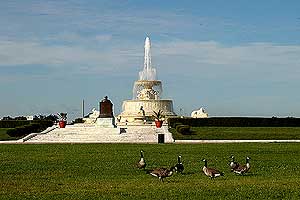 3. Belle Isle
Frederick Law Olmstead (with Michael J. Dee)
James Scott Fountain, 1925 – Cass Gilbert
Belle Isle Casino, 1907 – Van Leyen & Schilling
Belle Isle Aquarium, 1904 – Albert Kahn
Belle Isle Conservatory, 1904 – Albert Kahn
Livingstone Light, 1930 – Albert Kahn
Detroit Yacht Club, 1923 – George D. Mason
Belle Isle Police Station, 1893 – Mason & Rice
Two-and-a-half-miles-long and a half-mile-wide, Belle Isle is a low,
flat island rising just 2 feet above the level of the Detroit River.
Even before the city purchased Belle Isle in 1879, the island was
popular with Detroiters for hunting, fishing, bathing, and picnicking.
In line with the nation’s mid-19th century interest in urban parks, the
city hired landscape architect Frederick Law Olmstead, designer of New
York’s Central Park, to create a plan for the island. Olmstead’s sketch
called for a central road running up the island and a canal crossing
one end. This struck many as too minimal. City leaders were more
impressed with a scheme proposed by newspaperman Michael J. Dee, who
suggested a series of canals covering the island. In the end, both
Olmstead’s central drive and some of Dee’s canals were built. The
island’s original 700-plus acres were increased through land
reclamation to nearly a thousand acres in 1940.
Originally forest and marsh, Belle Isle was populated with a series of
individualistic buildings from the late 19th through the mid-20th
century. These included two private yacht clubs, a nature conservatory,
a maritime museum, a police station, an aquarium, a memorial fountain
and two editions of a casino. Also contributing to Belle Isle’s
character are the many picnic pavilions, footbridges, and public
statues that dot the island. Most of Belle Isle’s facilities are
located on the western half, as the island’s eastern end remains mostly
forested and in a nearly natural state. The original timber bridge to
the island burned in 1915. Daniel Luton designed the graceful
replacement in the classicism of the City Beautiful movement. This span
was renamed for war hero General Douglas MacArthur early in World War
II.
4. Lafayette Park
Ludwig Mies van der Rohe, and Ludwig Hilberseimer
1959-1963
Lafayette Park’s Chicago developers imported modern masters of
architecture and planning to design a new community for Detroit. The
master plan, one of Hilberseimer’s best, distributes high-and low-rise
housing across expansive superblocks – large blocks created by closing
streets. The Pavilion Apartments (1958) and Lafayette Towers (1963)
exemplify Mies’s trademark attention to form, proportion, and detail.
Nearly 200 units of two-story townhouses and one-story courtyard houses
were arranged around cul-de-sacs, as the overall development frames a
central municipal park. In its now mature landscape context, the modern
masters’ formula achieves its most engaging and timeless potential.
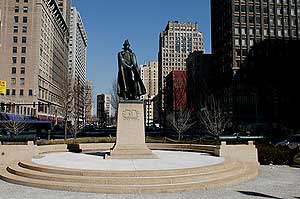 5. Washington Boulevard
Hamilton Anderson Associates
2004
From the 1807 Woodward plan, Washington Boulevard was to be developed
as an upper-class residential area.
Up until the early 1900s, Washington Boulevard was primarily
residential in character with a wide landscaped median that divided the
two directions of traffic.
The Washington Boulevard district, like most other districts in the
Lower Woodward area of Detroit during the early 20th century
experienced an unprecedented building boom. Unlike other areas in the
city, Washington Boulevard’s development was dominated by one private
entity and one vision, that of J. Burgess Book Jr. and his architect
Louis Kamper. It was Book’s dream to turn Washington Boulevard into
Detroit’s most exclusive address playing host to the most lavish
commercial and residential spaces in addition to creating the most
fashionable shopping district. Washington Boulevard was clearly
inspired by both the City Beautiful movement and the many grand
boulevards that Book admired in New York City and throughout Europe.
Today, the boulevard is relatively similar in composition as it was
when it was developed in the 1920s.
The eclectic stock of buildings and sizes that make up the extent
Washington Boulevard historic district individually represent examples
of some of the finest American commercial architecture of the early
20th century. Reaffirming the boulevard’s historical significance is
the fact that Washington Boulevard today is a product of “the Roaring
Twenties,” a large-scale planned real estate development carried out
primarily as an endeavor by one family and their architect.
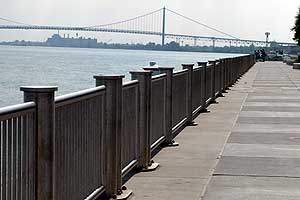 6. Civic Center Riverfront Promenade (Riverfront from Hart Plaza to Joe Louis Arena)
Albert Kahn Associates and Sasaki Associates
2001
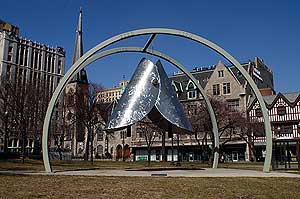
This linear park provides public connection to and along the waterfront
as it dresses up Downtown’s front door – to the river and to Canada.
The design includes figurative quotations from Detroit’s maritime and
industrial heritage. The serpentine seat wall resembles a giant rope
uncoiling along the metaphorical boardwalk. The coiled rope source at
the west end was designed for a future civic sculpture of monumental
proportions. The nearby mini-park is laid out to recall the geometry of
Detroit’s 18th century ribbon farms. A powerful new figurative
sculpture by artist Ed Dwight is dedicated to the Underground Railroad
at the stairs from Hart Plaza.
 7. Grand Circus Park
Judge Woodward 1805; The Albert Kahn Collaborative, 1998
The elegant semicircle of Grand Circus Park is a centering piece of the
baroque plan drawn by Judge Woodward after fire destroyed the city in
1805. Woodward intended for the city to be dotted by such open spaces,
in turn connected by broad thoroughfares. Woodward’s plan was thus a
more complex version of L’Enfant’s Washington, D.C., plan, with which
the judge was professional quite familiar.
In the mid to late 19th century the park was lined with elegant
mansions. Gordon Lloyd’s 1867 Central United Methodist Church at Adams
and Woodward remains from this era. Between 1890 and 1930, the park and
surrounding streets were built up with high-rise commercial towers.
Holding the corner at Adams and Park is the first Kresge headquarters
(now Kales Apartments), designed by Albert Kahn in 1914 and later
renamed the Kales Building. The relative uniformity of height and
massing of the surrounding buildings created an urban space comparable
to Philadelphia’s famed Rittenhouse Square.
The park itself features statues of prominent citizens, including
Detroit Mayor and Michigan Gov. Hazen Pingree (1840-1901). The fountain
to the west was named for and dedicated by Thomas Edison. The fountain
statue in the east park is by Daniel Chester French, creator of the
Lincoln in the Lincoln Memorial, and the preeminent American sculptor
of his day. An underground parking garage was built in 1956, and the
People Mover station opened in 1987. Although an exodus marked the
final decades of the 20th century, Grand Circus has benefited from the
reemergence of the Theater District and a renewed interest in urban
living. The park was renovated in the late 1990s in a classical manner
consistent with the spirit of the original Woodward plan.
8. C.L. Franklin Park (formerly La Salle Park)
Architect unknown
Nestled in one of Detroit’s early suburban middle-class neighborhoods,
the LaSalle Gardens Historic District rests one of the city’s few
unique neighborhood parks. It is rare these days to find a neighborhood
park that is well intact with a defined street-wall within the city
limits. The square, one-acre park is tightly abutted by an eclectic
collection of 1920s period homes and is ideal for neighborhood scale
activities.
 9. Monroe Street
Various architects
1850s-
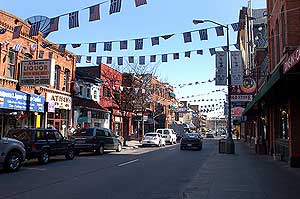
Greektown has been a traditional center of ethnic retailing in Detroit
throughout its 140-year history. It evolved from the farm of a French
pioneer settler to a German residential and commercial area, and
presently is a flourishing Greek commercial zone. It is also one of the
last viable Victorian commercial streetscapes in downtown.
Greektown was originally part of the Beaubien Farm, beginning in 1758.
With successive generations, the land was subdivided and sold in the
1830s, a time of German immigration. Germans dominated this area for 70
years. During this period, they shared the area with other ethnic
groups. The first Jewish synagogue was located here, and blacks settled
the area as well.
As the German community became more prosperous, between 1905 and 1910,
they moved out and were quickly replaced by Greeks. The first known
Greek settler arrived in the city in 1890 and was able to foster Greek
prosperity in the early part of the 20th century by helping others
start businesses. Gaining affluence, Greeks began to move their
residences. By the 1920s Greektown was predominately commercial.
Commercial and institutional development replaced the last residences
in the 1950s and 1960s, and the transition from residentially oriented
businesses to restaurants and entertainment was accelerated. Greektown,
once a four-block area, was reduced to one block as all the surrounding
structures became parking sites or institutional buildings.
 10. Hart Plaza
Smith, Hinchman, and Grylls, with Isamu Noguchi
1979
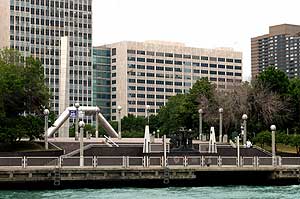
At the center of Downtown’s waterfront, Hart Plaza was designed to
serve many purposes, including the city’s festivals, Independence Day
and less predictable Stanley Cup and NBA Championship celebrations.
Noguchi’s fountain, the focal point of the plaza, is impressive when
wet, and even more when lighted and wet at night.
All Photographs Copyright Dave Krieger
Related Articles
CDFIs investments in childcare allows daycares like Detroit’s Lil Love Bugs to further invest in children’s futures
Childcare is not a family issue, but a workforce issue. Members of the MI CDFI Coalition showcase how investing in quality, affordable childcare and early childhood education positively impacts the entire community.

Partner Partner Content Don’t Let Fraud and Scams Ground Your Summer Vacation
Planning a summer getaway? Before you book, learn how to spot common travel scams and protect your money so your vacation stays stress-free.
Juneteenth: Freedom’s promise is still denied to thousands of blacks unable to make bail
Just as with so many other criminal justice policies, pretrial detention disproportionately affects African-American men and women, destabilizing black families in the process.