Plant Power
Innovative Detroiters are using fields of flowers and native plants to help turn brownfields into greenfields.
One proposed use for vacant land in Detroit is farmland.
But what if the land is too polluted to produce safe food? There is a
natural way to clean up soil. It’s called phyto-remediation, and it
basically puts plants to work removing toxins as they are handling
their regular business of extracting water from the earth.
Here are the stories of two Detroit groups currently working in the realm of phyto-remediation.
Phyto-remediation 101: Sunflowers and schools
Brownfields
are parcels of land that were once used in a potentially polluting
manner and oftentimes harbor ground pollutants. The city of Detroit is
littered with them. Technically, the entity that polluted the land is
responsible for its clean-up, but there are so many loopholes that the
very existence of a potential brownfield can act as a barrier to its
reuse.
 To further complicate matters, there are types of uses
that (for good reason) require higher levels of soil cleanliness — such as a school or a residence.
One expensive but sure way
to remove polluted soil is to actually cart it away and replace it with
clean soil. Not only is this method costly, but it begs the question:
where does this toxic soil end up?
Co-lab* is a small design firm oriented towards
sustainable architecture and planning projects. Co-owner Vibeke
Schroeder Vendena is a native of Denmark who first worked Detroit in 1996 and
became fascinated with the city. After several other trips, she returned in 2001 to attend Cranbrook
and became involved in a landscape design project at Bunche Elementary
on the Eastside near the Heidelburg Project.
After testing the soil, the team found some areas had high levels of heavy metals, like lead, that can be dangerous for children. They quickly
realized the cost-prohibitiveness of removing and replacing all of the soil, so they began researching phyto-remediation that uses, as Vendena puts it, “plants as pumps.”
They learned that there
are certain plants that are better at this than others. Sunflowers, for
example, have shallow roots and are good first-year crops, removing
toxins down 8-10 inches. The team then plants native poplar trees and perennial plants
like prairie and switch grass which have an expansive root system to go
down and extract even deeper toxins.
 The sunflowers have already proven to reduce lead in parts of the soil from 1000 to 800 parts per million. Vendena plans to have the
soil re-evaluated in a couple of years to test the effectiveness of the other plants they have selected, but is hopeful that the
phyto-remediation will be successful as it has been in similar
situations in Australia and Canada.
“This is a low-cost
solution,” says Vendena, adding that it’s a solution that could have broad applications around the city. Co-lab* also hopes that “by teaching it to
kids, they will think, ‘Wow, sunflowers can do this!'”
Biofuel crops grown around the block?
Growing
crops for production into biofuels is a burgeoning industry in this
country and has typically been done in rural areas. But
there is one initiative exploring the feasibility of using land in the city, where ultimately most of the fuel will be consumed.
The
bonus, according to this initiative’s lead, Brad Jensen, is that the
“use of land for biofuel production is preparing, cleaning [the land]
for later potential redevelopment.” That’s right, the very same crops
that work well as fuel work well as phyto-remediators.
Jensen
is project manager of a program at City Connect Detroit called the Detroit Data Partnership that works to optimize the existing network of data,
information and demographics that are really only useful when organized
into a digestible format. They also work to make that information available to the
city government and nonprofits.
In analyzing all this raw
data, Jensen was struck by the sheer quantity of vacant parcels, many
of them brownfields. While contemplating potential productive uses of
this land, two things happened: he heard a NextEnergy presentation on
phtyoremediation and happened to see the sunflowers that Ford Motor
Co. planted around the Rouge Plant. He started thinking of these
crops in terms of a business model: “This could not just be a good
thing to do, but it could pay for itself.”
 Jensen points out
that biofuel production is on the rise nationally (and locally: a plant
is in the works for the New Center area), and he realized that where
biofuel crops originated from would become more and more important.
Transporting crops from rural areas to urban consumers adds a
significant cost to whole equation.
He is now working with a
team of modeling experts from Eastern Michigan University to study the
feasibility of growing biodiesel crops — such as rapeseed, switchgrass
and sunflowers — in the city. Lots of unanswered questions remain,
like how much land is actually vacant (yes, no one actually knows that
magic number), and whether or not there are large enough contiguous
parcels that could logistically work as biofuel farms. Environmental
impacts need to be looked at, and economic and transportation models
need to carried out.
Jensen is on the hunt to secure long-term
funding for the study. He hopes it will be completed in 2010. “Our
target is biofuel production, but there are ancillary benefits,” he says, noting the social impact that greenfields vs. brownfields can
have on neighborhoods. What would you rather look at — a typical vacant lot or rows of sunflowers that will ultimately become
fuel for your truck? Seems pretty obvious.
Kelli B. Kavanaugh is the development news editor for Model D. This is the latest installment of her ongoing series on sustainability in Detroit. Her past stories have been about community gardens and energy efficient building.
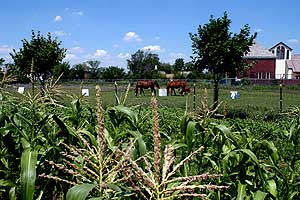
Sunflower and corn photos Copyright Dave Krieger
Related Articles

Juneteenth: Freedom’s promise is still denied to thousands of blacks unable to make bail
Just as with so many other criminal justice policies, pretrial detention disproportionately affects African-American men and women, destabilizing black families in the process.
Michigan Adventurer to Bike 1,000 Miles Across State to Spotlight Hidden Form of Domestic Abuse
A Michigan adventurer is biking over 1,000 miles across both peninsulas this summer to raise awareness about economic abuse: a hidden form of domestic violence that affects countless survivors across Michigan.

Detroit schools are making real gains in reading and math: 4 strategies that are working
The city’s schools are making progress faster than peer districts, but that progress could be fragile.