Smart Ideas for Detroit from the Creative Cities Summit 2.0
Creative minds coming together, bringing big ideas for cities to Detroit — that’s our idea of a good time. Fine, say it. We’re city geeks. Our Model D team reveled in it at the Creative Cities Summit 2.0 last week and mined the sessions and speakers to bring you these thoughts for our fair city.
There were a lot of smart people mingling at the Ren Cen last week. People who love cities, fight for cities, study cities and live/work/play in cities got their brains together for a few days in Detroit for the Creative Cities Summit 2.0.
The conference drew people from around the country and around the globe to share ideas big and small for creating better urban places.
In the following dispatches from the summit, Model D collects some of the best ideas — things that Detroit could use to make our own city more creative-friendl and to retain our talent.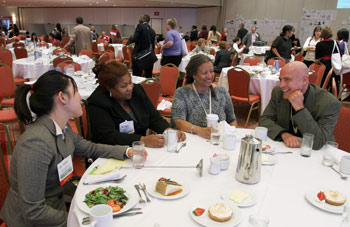
Throw out the rule book
On Day 2, The Art of City Making author, Charles Landry, told a simple story of bicycle bells. A Canadian city used to issue a $70-some-dollar fine for bikes that didn’t have them. The administrative fee for issuing and processing the actual fine weighed in at some 100 bucks. What’d a certain free-thinking city gov’t official do about it? Armed a few park rangers with bells and screwdrivers and gave citizens the choice of either getting a free bell put on their bike, or paying the fine.
Since, only one person has chosen to pay the fine.
Now, we’re a city with a lot of rules. And in the past year of mayoral mayhem, we saw a lot of rules broken, twisted, and completely disregarded. If they are that easy to manipulate, perhaps they weren’t that good to begin with.
So start thinking, city officials, employees, and even residents. Are there city fines that are antiquated? Are there city services out there that just don’t make sense? What on our city charter is completely out of whack? Is there still a fine for sleeping in bathtubs on our books?
And we’re not suggesting creating a lawless city, just one where the rules are modern and make sense and come with a delicious coating with of ingenuity.
Here’s an idea: What about budget cuts in the DPS? If arts and computer programs get cut, should that mean kids don’t get to learn those skills at all? Put the call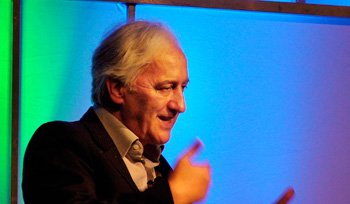 out to local creatives and even tech companies willing to take on pro bono work. Teachers are everywhere. They may just not appear in the pages of your current rule book. – Jen Andrews
Play nice with bands: musicians are our friends
One of the most refreshing things to hear at the summit was at a session on Music and Economic Development. Basically, the theme of the session was this: “If you think you are going to create coolness, you are going to fail. But you can nurture it.”
Without its music scene a place like Austin, Texas, would be reduced to a wishy washy Ann Arbor.
Ed Bailey, vice prez of brand development for Austin City Limits, says Austin was always a music town, but through its stellar festivals and artist-friendly environment, it’s become a haven for musicians, and maybe just as importantly is now a haven for other people who like to live around cool people, like musicians.
Bailey helped develop the Austin City Limits Festival, but just as important as the big fest that bring in gaggles of bands and fans are the ways communities can make the artists feel welcome and supported year round.
“Part of this hast to be about nurturing the artists in your own midst,” he says. In Austin, the visitors bureau sponsors local bands to play at the airport. What a way to welcome for visitors, plus it’s no doubt a nice paycheck for the artists and a solid reinforcement of the Austin music-related brand. There’s an idea Detroit could steal.
In Austin, the convention and visitors bureau has a music marketing arm that integrates music-planning into events that come to town – like meetings and conventions — thereby connecting artists with potential clients an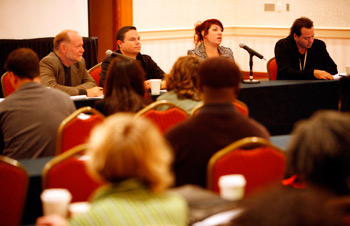 d again reinforcing that music brand. Smart stuff.
“It is important to know how to relate to the artists in your town,” Bailey says. Give them a warm stage to play on and plenty of cold drinks, protect them and nurture them. Then the scenes will grow. Then you can claim coolness.
All the panelists agreed that Detroit’s got the talent, the music, the festivals – but if the city gaining a rep for not supporting its own, a place you’ve got to leave once you’ve made it, then maybe we all ought to listen up a little more closely when guys like Bailey speak. — Clare Pfeiffer Ramsey
Brush up on Marketing 101
Big business, small business. Community organization, charity. However it is you want to or can contribute to our city, you gotta know a couple things about promoting the heck out of yourself.
That’s where the D Brand can come in handy. They’ve approached branding the city’s identity much like a Fortune 500 company would with brand statements, toolkits with logos and type treatments, and the many ways that you can align your biz or org with their brand, too.
Think of it. You’re not just a tech startup in the city. You’re part of the bigger platform that’s the Detroit Creative Corridor that’s also part of the larger D Brand. You’re not just a hair salon in Midtown about to open for business. You’re part of a small business organization that’s also part of the University Cultural Association that’s, of course, also part of the larger D Brand.
And when it comes to actually telling people around town who you are, mouse away from the horror of DIY flyers and MS Word clip art. Let a pro help you.
There’s no shortage of hungry for work Mad Men around town who have the ideas and know-how to promote your bus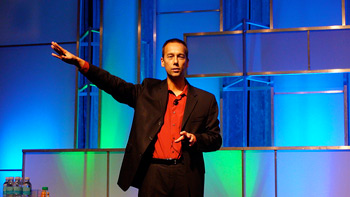 iness and organizations. From graphic and web designers to writers and strategists, put the word out and they will come. If you’re a larger organization, take a look at local PR, advertising and marketing firms for help. There are a lot. Let them help plug you into the larger idea pool. Let them help you dump that logo someone’s kid cooked up at camp and instead turn your ideas into a real name that has a real future in our city. — Jen Andrews
Objects are larger than they seem
The evening keynote speaker at Day 1 of the Creative Cities Summit 2.0 was Bill Strickland, president of Manchester Bidwell Corp. of Pittsburgh and Oprah-level deity in the world of creative economies.
Strickland gave an inspired talk about his 40 years of experience in social and economic development in “the poorest neighborhood with the highest crime,” his leitmotif for the evening. Strickland, it turns out, was practicing the core principles of the “Creative Class” movement when Richard Florida was still playing with his Lite Brite.
He started a community center that taught the people of his neighborhood arts and technical skills, and as the center grew he added training facilities – but only if they were the same world-class facilities you would find anywhere else. A building designed by a disciple of Frank Lloyd Wright. A gourmet cooking training facility. An orchid greenhouse. The country’s best jazz recording studio. All in the poorest neighborhood with the highest crime.
Strickland’s mantra is that people are the product of little things, and environment drives behavior. In Detroit, the Creative Class is already here, it just needs to be given a chance. Surround yourself with beautiful things and you will elevate yourself and everyone around you.
It is an inspiring message that speaks to Detroiters as individuals and as a city. I can’t wait to read his book, Making the Impossible Possible. And to go buy some fresh flowers, as he recommended. — Supergay Detroit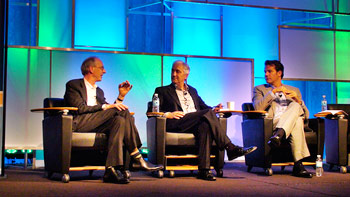
Roll out the red carpet, for everyone
Three key communities are typically seen as agents for positive development in disadvantaged urban areas: artists, immigrants and the GLBT community. Traditionally considered fringe communities, in the bizarro new world of the creative economy they’ve moved center stage. One of the breakout sessions at the Creative Cites Summit 2.0 took a look at the role of these groups in community development.
One representative for each community spoke to an audience curious to hear how their cities, too, can have these awesome fringe communities. It turns out while the net effect of these groups tends to be urban renewal, each has unique characteristics and motivations. Artists look to disadvantaged areas for economic refuge — inexpensive rents, big spaces for creativity. Immigrants look to create cultural refuge as a launching pad to greater assimilation and prosperity. The GLBT community looks to create social refuge, places where they can freely express their identities.
A woman from El Paso asked how her city – which is very interested in creating an area for artists and other creative types – can attract these groups, as calls to artist and GLBT groups have gone unreturned. It turns out you can’t buy “cool.” Panelists agreed a top-down effort will never work. The only way to attract these groups is to define spaces where people can live without fear, and let the rest take care of itself. (For more on that topic, click here). — Supergay Detroit
Jen Andrews is a local freelance writer who spends part of her days in Detroit’s ‘Mad Men’ world. Supergay Detroit is an award-winning Detroit blogger, whose coolness can’t be bottled and sold, but possibly can be cloned. Clare Pfeiffer Ramsey is managing editor of Model D. Send comments and feedback here.
Photos courtesy of the Creative Cities Summit 2.0
Lead & Music and Economic Development panelists
photographs by Marvin Shaouni
Marvin Shaouni is the managing photographer for Metromode & Model D.
Related Articles
Juneteenth: Freedom’s promise is still denied to thousands of blacks unable to make bail
Just as with so many other criminal justice policies, pretrial detention disproportionately affects African-American men and women, destabilizing black families in the process.
Michigan Adventurer to Bike 1,000 Miles Across State to Spotlight Hidden Form of Domestic Abuse
A Michigan adventurer is biking over 1,000 miles across both peninsulas this summer to raise awareness about economic abuse: a hidden form of domestic violence that affects countless survivors across Michigan.
Detroit schools are making real gains in reading and math: 4 strategies that are working
The city’s schools are making progress faster than peer districts, but that progress could be fragile.